

The uncomfortable truth is that, while most AI prototypes work, they still fail in the end. The reason is simple. Many AI projects end with a technical proof of concept, which only confirms that something is possible. From that moment on, the real work begins: feasibility must be translated into reliable operations. It is precisely this transition that repeatedly breaks down.
In our work with organisations, we repeatedly observe the same pattern. After a successful demo, the initiative loses its clear place within the organisation. The innovation team has fulfilled its mandate, the business unit expects the next step, and a vacuum emerges in between. Ownership, operating model and decision-making processes remain unresolved. A few months later, the prototype still exists, but without any anchor in day-to-day operations.
Those who fail to actively shape this transition do not lose the prototype. They lose the impact it could have delivered.
The PoC Paradox: Success as a Dead End
A study by IDC and Lenovo reveals that only 12 per cent of AI proof of concepts (PoCs) make it into production. On average, only four out of 33 prototypes ever go live. Meanwhile, global enterprise AI investment reached $252 billion, according to the 2024 Stanford AI Index – up from $201 billion the previous year.

The willingness to invest and the technical feasibility are both present. What is missing is the transition from a working prototype to productive operations. A successful proof of concept (PoC) does not usually address what functioning AI actually looks like in day-to-day business, nor who takes lasting responsibility for quality, operations and further development.
This aligns with our observations in practice. We see organisations that build technically strong prototypes but then get stuck. Budgets run out at the pilot stage, responsibilities remain unclear, and the business unit develops parallel workarounds, often in the form of Excel solutions, because operational pressure demands a quick alternative.
| → In practice: The most critical moment in an AI project often comes directly after a successful proof of concept (PoC). While the demo generates buy-in and the team gains momentum, one central question frequently goes unanswered: who will be responsible for operations in day-to-day business? We often see this issue remain unresolved for weeks or even months. In the meantime, the business unit implements pragmatic interim solutions – often manual ones – because operational demand continues regardless. As a result, the AI system gradually becomes irrelevant until interest fades and the PoC is filed away as a completed experiment. |
What Really Happens After the Demo
After a successful PoC, initial enthusiasm meets reality. When it comes to productive deployment, questions come to the surface that were barely visible during the pilot – yet they determine speed, risk, and reliability. Who secures the budget for ongoing operations? Who keeps prompts and rules up to date as processes evolve? Who takes responsibility when a recommendation is wrong and errors ripple into day-to-day business? As long as these points remain unresolved, the prototype is convincing on paper – but implementation stalls.
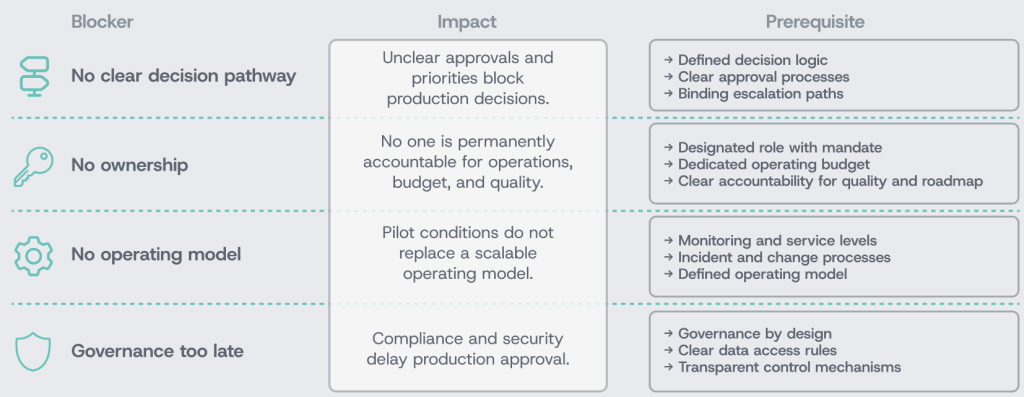
In practice, these problems can typically be traced back to four gaps that slow the transition into production. Each one is significant on its own; together, they cause decisions to stall, operations to remain unstructured, and the momentum built during the PoC to dissipate.
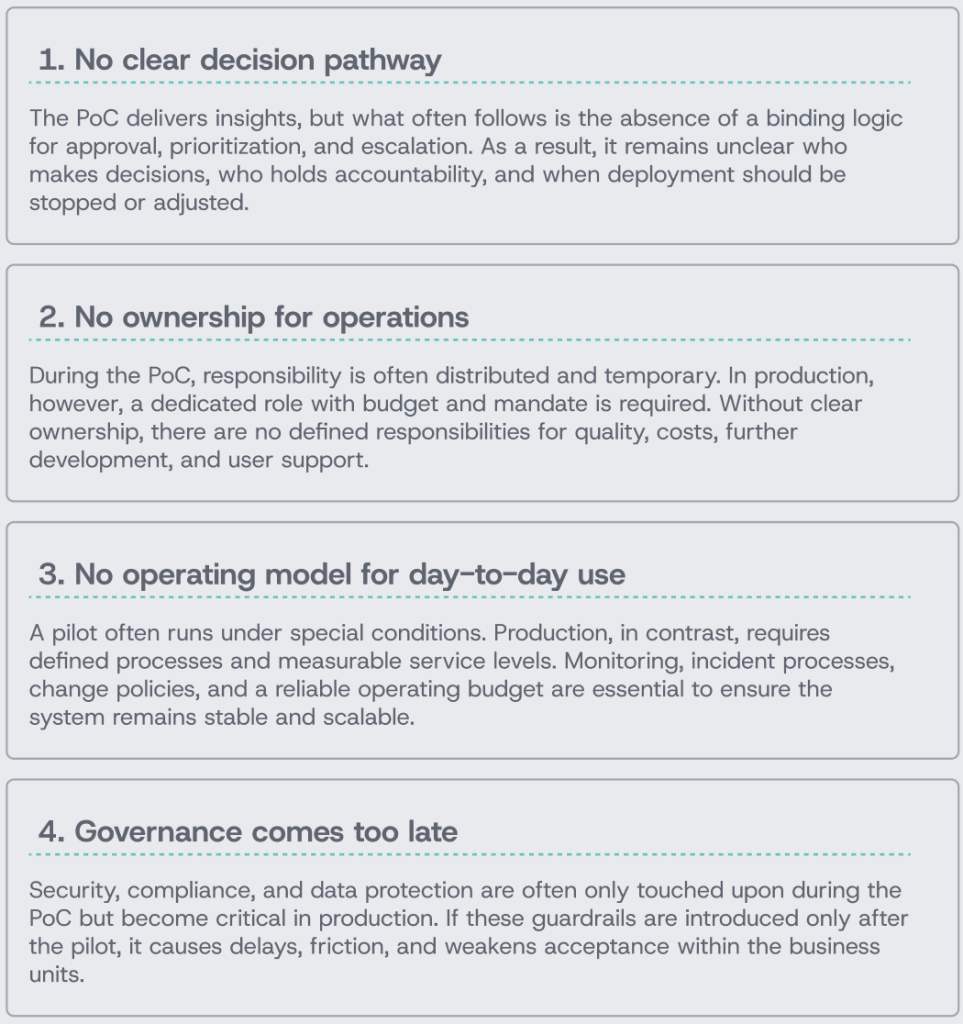
This is a recurring pattern: The PoC is delivered within a few weeks. Then the process of clarifying governance begins. What data is the model allowed to access? How is bias reviewed? Who signs off on recommendations? Five months later, the business unit is frustrated and has developed its own workaround. The AI project is internally labelled ‘too slow’. It was not the AI that was slow; the organisation was simply not prepared.
During this phase, acceptance of the AI initiative is often lost. Reliability and operational stability only become apparent late in the process, by which time day-to-day operations have long since adapted to alternative solutions.
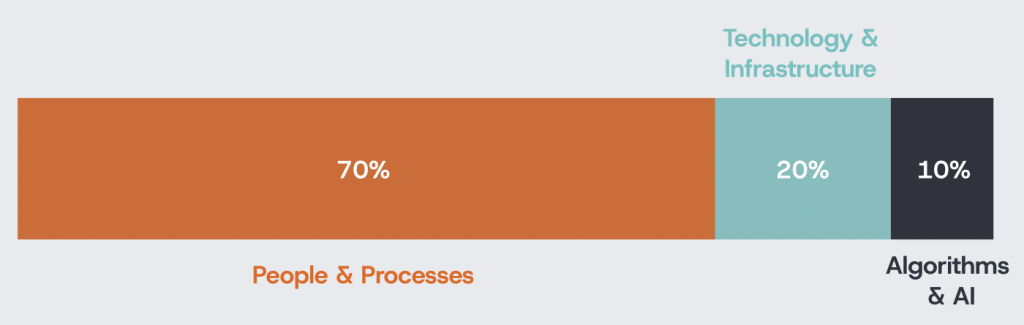
Where AI Projects Really Get Stuck: 70-20-10
A consistent pattern emerges across industries. Approximately 70 per cent of friction losses stem from people and processes, around 20 per cent from technology and infrastructure, and about 10 per cent from algorithms or models. Therefore, the greatest lever lies not in the technology itself, but in how it is deployed. The transition from prototype to production is only complete when AI is working reliably in day-to-day operations, has been accepted by those using it and is delivering lasting value.
1. From Project Thinking to Product Thinking
Many organisations treat AI like a time-limited project. This leads to a predictable pattern. The PoC is declared a success, the project team disbands, and the next step is left without clear accountability. A product, however, only truly begins with operations, budget, and ownership. That is why ownership, budget, and operational responsibility should be firmly established before the PoC ends. It sounds obvious – and yet it rarely happens in practice.
| → In Practice: Often, asking a single question at the outset can make the biggest difference: ‘Who will be running this in six months?’ If nobody can answer immediately, the proof of concept lacks the foundation for productive operations and will most likely remain a convincing demo with no path forward. We now ask this question directly at the start, as the responses tend to be more informative than any preliminary feasibility assessment. In one case, this clarification alone resulted in the PoC being delayed by three weeks, allowing time for the operating model to be outlined first. This saved months later on. |
2. Data Governance Before Algorithms
Prototypes often appear stable because they are built under conditions that rarely reflect everyday reality. During the proof of concept (PoC) stage, selected data is used and approvals are handled pragmatically. However, once the step into production is taken, the requirements shift. What matters then is a data foundation that is consistently available and maintained transparently and in a traceable way, delivering reliably.
This all sounds like basic groundwork: clear data sources, regulated access rights and binding quality standards. Yet these foundations are often missing in many initiatives. Data preparation is often given only a small fraction of the overall project time, despite poor data quality being the most common reason why AI initiatives fail.
This is why we start earlier and work with production-grade data from the outset. The prototype may therefore feel less polished, but the transition into operations becomes significantly more predictable. Based on our experience, this approach adds one to two weeks to the PoC while reducing the subsequent production phase by several months, as any issues with the data that would typically derail a project are identified during the pilot instead.
3. The Scepticism Gap: Change as Real Work
In many organisations, there is often a clear contrast between the enthusiasm of senior management and the scepticism of those involved in day-to-day operations. This scepticism does not stem from outright rejection; it follows an entirely understandable logic. AI shifts responsibility and changes control points, raising the pressure on performance as decisions must be made faster and mistakes become more visible.
We have found that acceptance grows most where there is proximity to real practice. Teams adopt new tools much more quickly when they can see, through concrete workflows, how their colleagues are achieving reliable results with them. Middle management plays a particularly important role here, as this is where operational responsibility and performance targets converge. This level requires clarity regarding roles, decision-making powers and rules for everyday use, so that adoption feels safer and the AI system is established as a reliable part of the working process.
| → In Practice: The most successful rollouts follow a simple principle: a small number of multipliers within the business unit model the new way of working as part of their daily routine. This simultaneously builds trust, encourages adoption and accelerates progress. By using the digital product or AI tool as part of their everyday work, the multipliers provide guidance for their colleagues. Often, three to five people are enough to make usage visible, raise practical questions early on, and build acceptance within the team. An approach that prioritises closeness to actual application is particularly effective. While a large launch communication generates attention, it rarely sustains it beyond the first few weeks. More traction comes from closely supporting two key users in the business unit to ensure they reliably apply the system in real workflows. After three to four weeks, other team members will often actively ask for access because they will have seen the value of the system and gained the confidence to use it in their everyday work. |
Development Realism: Build, Buy or Partner?
A three-month proof-of-concept project can quickly turn into a twelve-month production project if architecture, data, security and operations are not properly addressed from the outset. Many organisations underestimate this time gap, which remains invisible during the pilot phase but only becomes apparent later in the form of delays to day-to-day business.
A partner can save time by working with proven approaches and established operating patterns. Speed comes from repeatability and clear processes. Vendor lock-in is a common concern in this context, but it can be mitigated through sound architectural decisions, documented interfaces and consistent data ownership. In many cases, time lost due to unresolved foundations is the single most significant risk factor.
This is precisely where our approach at DevelopX comes in. Together with the internal team, we shape the transition from PoC to production, ensuring that decisions are transparently documented so that knowledge stays within the organisation. We define architecture collaboratively, consider operations from the outset, and structure every engagement with a clear objective and defined endpoint. Data ownership remains with the client throughout, enabling a sustainable pace of progress in the long term.
Five Diagnostic Questions for Your Next AI PoC
Before starting your next PoC, it is worthwhile carrying out a brief reality check. These five questions do not require detailed answers, but they should provide enough information to make decisions and allocate responsibility:
- Is there a clear definition of what constitutes productive operations?
What does ‘productive’ mean in concrete terms? Which user groups will work with it? Which processes will be affected? What service levels will apply? How will success be measured? - Have ownership and the budget for operations been formally established?
Who is responsible for the roadmap, quality, costs and approvals in ongoing operations, and what permanent budget is available for this? - Is governance embedded in the design?
Are security, compliance and risk requirements integrated from the outset, including clear rules for data access, reviews and sign-offs? - Are there transparency and control mechanisms for day-to-day use?
Are outcomes traceable? Are thresholds defined? Are escalation paths in place? Is it clear when a human takes over? - Are operating costs realistically calculated?
Are monitoring, updates, data maintenance and user support planned as ongoing efforts, with defined responsibilities and capacities beyond the proof of concept (PoC)?
From Demo to Value Creation
For most organisations, the experimentation phase is now complete. Models are available, tools are well-established, and, in many cases, feasibility has long been proven. This shifts the central question. The important thing now is to understand why AI is not yet delivering measurable value within your organisation.
The answer usually lies in organisational structure. Whether a PoC transitions into reliable value creation depends on ownership, governance, data foundation and operating model. Laying the groundwork for these early on saves time, because the path to production becomes planable. It creates reliability because results remain stable in day-to-day operations. It also creates investment security because a budget for experiments becomes manageable business impact.
If your PoC has delivered but the path to production is still open, it is worth taking an honest look at what is blocking progress. In 30 minutes, we can review what is slowing your transition and the decisions that need to be made next. Get in touch directly and we will find a time.
Digital. Growth. Delivered.