The digital transformation affects not only the use of new technologies. It also changes how companies must be organized to stay competitive. Traditional, functionally oriented structures quickly reach their limits when developing innovative digital products and adapting to changing market conditions.
A product-driven organization places the product at the center of its strategy. This means that teams, processes, and technology are consistently organized around value.
The challenge: many companies do not know how to implement this change.
Typical symptoms of a non-product-driven organization
Despite modern tools and a drive to innovate, many organizations lack a clear focus on products and customer benefits. Instead, structural weaknesses and inefficient processes slow down innovation and market success.
- Assumptions over evidence
Often, decisions are based on internal assumptions or stakeholder interests instead of customer feedback. This means that products fail to meet demand. Digital Sales & Customer Experience programs help close this gap by grounding decisions with user data. - Slow coordination blocks speed
Lengthy coordination across hierarchical levels and complex committees delays strategic decisions. Silo thinking between product, IT, marketing, and sales blocks collaboration. It also disrupts information flow and makes prioritization more difficult. - Too many initiatives, no clear focus
Without clear prioritization, companies get bogged down in too many initiatives. They often fail to assess which ones truly create customer benefit or business value. This results in resource overload, unclear responsibilities, and inefficient development. - Outdated tech limits agility
The technological basis is also often outdated. IT systems and monolithic architectures prevent agile, data-driven work. They also block fast responses to customer feedback. - Unclear ownership weakens accountability
Decisions often fall short due to a lack of accountability. Issues escalate upwards, priorities stay unclear, and conflicting objectives go unresolved.
This is especially evident in the daily work of product teams. Rather than working iteratively, they get stuck in coordination and approvals. They lose speed, impact, and motivation.
This is especially evident in the daily work of product teams. Rather than working iteratively, they get stuck in coordination and approvals. They lose speed, impact, and motivation.
The solution: introducing a clear management model
An effective digital operating model enables a product-driven organization. It does so by defining clear decision-making structures, priorities, and responsibilities. Instead of slowing down processes with rigid hierarchies and lengthy coordination, it has an agile and focused way of working.
Decisions are made where the most relevant information is available. This allows product teams to work more efficiently and react more quickly to market changes.
The right balance between strategic leadership and operational autonomy is crucial here. An overarching product roadmap ensures that all initiatives support the company’s goals. At the same time, teams are given the freedom to act flexibly and based on data. This promotes customer focus, reduces internal friction, and creates an environment where innovation is developed and implemented. A clear governance structure ensures resources are used efficiently and priorities align with business and customer value. A product-driven organization not only accelerates product development. It also strengthens market and customer focus, key to long-term company success.
How product-driven organizations create measurable added value
The change to a product-centric organization is not only a cultural experiment, but also an effective economic lever. Companies that consistently align structures, processes, and decision-making with product and customer value see clear results: faster development, greater market relevance, and more efficient use of resources.
“Product-oriented organizations do not think in terms of functions, but in terms of value streams. They organize themselves around what actually generates impact along the entire value chain.”
Speed and flexibility in the product cycle
A key effect is the reduction in time-to-market. Autonomous product teams, clear decision-making models, and iterative development make it possible to add new features and ideas faster. Strategic decisions are decentralized. Operational autonomy increases, and so does the speed of innovation.
Focus on business value instead of project inflation
In traditional setups, companies often get lost in too many parallel initiatives. Product-driven organizations take a more focused approach. They prioritize based on clear criteria: customer value, market potential, and strategic fit. This increases implementation efficiency and reduces the waste of internal resources.
Reduction of operational complexity
Cross-functional teams, clear responsibilities, and transparent governance reduce internal friction. Silos are broken down, coordination is minimized, and escalations are reduced. The organization gains structure and clarity. This is reflected in higher productivity and faster decisions.
Data-based management as a success factor
Decisions are made on Data & AI Solutions, customer feedback, and market signals rather than instinct or agendas. The result is products that are better tailored to the market. This can be continuously developed and enables real differentiation.
Economic effects at a glance
- 30% faster time to market
Companies can measurably speed up their product development by relying on autonomous product teams. Decentralized decision-making and iterative processes speed up the rollout of new functions. They happen directly on site, without delays or detours. - 40% more resource efficiency
Consistent prioritization allows product-driven organizations to focus on the essentials. Initiatives with clear customer benefits and measurable business value. This reduces wastage and significantly increases the implementation rate. - Less coordination, more clarity
A clearly defined management model with unambiguous responsibilities prevents escalation and coordination loops. Decisions are made faster and with greater purpose and efficiency. There’s no need to route them through hierarchies or committees. - Higher product-market fit
With data-based feedback, products can be developed based on real user behavior instead of assumptions. This increases market relevance, reduces undesirable developments, and strengthens long-term success. - More execution power in the team
Cross-functional teams with genuine end-to-end responsibility work more focused, autonomously, and are results-oriented. This not only increases productivity, but also identification with the result, and therefore its impact.
These effects are not a coincidence. They are the result of a consistently designed organizational architecture. Product-driven teams ensure that technology, teams, and processes contribute to measurable business impact. They don’t get lost in functionality and operational chaos.
Product orientation is not just an organizational model, but a strategic competitive advantage.
The six dimensions for a product-driven organization
The key to a product-driven organization is a holistic model that connects every part of the business. Six core dimensions shape how well a company can develop, scale, and position its products in the market.
These include a clear strategic direction, the right organizational setup, product-centric governance, and a tech architecture built for rapid innovation.
When all these elements align can a powerful, customer-centric product organization be created. One that remains competitive in the long term.
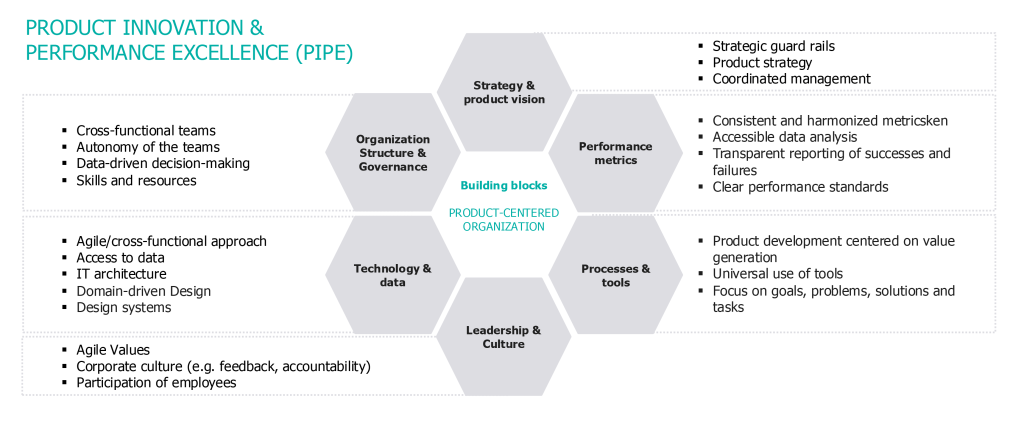
1. Strategy & product vision: clear goals for digital products
Every product-driven organization starts with a clear vision:
- What should the digital product achieve?
- What added value does it offer the customer?
- How does it contribute to the business objectives?
A clearly defined understanding of the product helps to make strategic decisions and set priorities.
2. Organizational structure: cross-functional teams instead of silos
Traditional companies often work in functional silos. Marketing, sales, IT, and product management are separated from each other. A product-oriented organization, on the other hand, builds its structure along the customer journey.
Typical structure of a product-centric organization:
- Cross-functional teams with clear responsibilities
- End-to-end ownership along the entire product life cycle
- Autonomy of the teams for fast decision-making
This results in fewer dependencies, faster iterations, and greater customer focus.
3. Technology & data: Align architecture with business logic
Many companies struggle with monolithic IT systems that slow down innovation. A product-driven organization and a review of Tech Architecture is the answer:
- Domain-driven design, where technology is directly aligned with business requirements
- Data-driven decisions to continuously optimize products
- Modular architectures that enable rapid customization
Technology must not be viewed as an isolated unit, but must actively contribute to the added value of the product.
4. Leadership & culture: away from top-down, towards ownership
In a product-driven organization, the management culture also changes:
- Moving away from classic top-down decisions
- Towards self-organized teams with clear responsibility
- Introduction of value stream owners with end-to-end responsibility for specific product areas
The aim is agile decision-making in which teams have the freedom to drive innovation forward independently.
5. Processes & governance: balance between structure and flexibility
Without a clear governance model, agility quickly leads to chaos. A product-oriented organization needs:
- Coordinated roadmap management between teams
- Effective decision-making mechanisms that take into account the autonomy of the teams and
- Iterative development processes that are based on customer feedback
Clear prioritization models play a key role here to ensure that teams focus on the right initiatives.
6. Product development process & prioritization: From idea to impact
Many companies do not have a clear roadmap for the development and prioritization of new products. Important steps in this process are:
- Discovery phase: Identification of customer needs and market opportunities
- Validation: Hypothesis-driven tests to validate product ideas
- Agile implementation: development in iterative sprints with continuous customer feedback
- Measurable prioritization: Clear decision criteria for product roadmaps
Measurable prioritization: clear decision criteria for product roadmaps
The aim is to develop products that are not only technically feasible but also relevant to the market.
Five concrete steps for getting started with a product-oriented organization
The way to a product-oriented organization does not begin with a reorganization on the drawing board, but with targeted, implementable steps that have an impact. To align structure, culture, and processes with the product, companies need a conscious start. It should be focused, practical, and show measurable progress.
Below are five tried and tested steps to effectively initiate change:
1. Determine location: Where does the organization stand today?
Before initiatives are launched, a well-founded assessment of the current situation is required. In a compact workshop with the relevant product teams, the maturity level of the organization is analysed based on key questions. Which structures are already product-oriented? Where are the gaps? Which levers promise to be effective in the short term?
Goal: To create a common understanding of the current situation and lay the foundations for sound prioritization.
2. Sharpen your focus: What is really relevant?
The areas of action are prioritized on the basis of the workshop. The following questions are asked: What has a direct impact on customer benefit and company value? Which topics are currently blocking the product teams? The focus is on the areas with the best ratio of impact and feasibility.
Goal: To deploy resources in a targeted manner and distinguish quick wins from strategic construction sites.
3. Starting implementation: launching the first initiatives
Get to work with clear priorities. Typical first steps include an overarching product vision and clarifying roles and responsibilities. They also involve questioning prioritization logic and making the development process more data-based. In this step, it is crucial to launch concrete measures and not to perfect concepts.
Goal: Create momentum and show that the product organization is more than just a new organizational chart.
4. Integrate impulses from outside: Adapting best practices
Setting up a product organization does not have to start from scratch. Benchmarks, proven models, and the experience of other companies help identify blind spots and speed up learning. It is important to be inspired rather than using a blueprint.
Goal: Accelerate implementation and ensure quality by thinking outside the box.
5. Clarify governance: Responsibility instead of hierarchy
Product orientation only works with clear decision-making models. Here, governance does not mean control, but orientation. Roles such as the Value Stream Owner ensure end-to-end responsibility.
They reduce coordination effort and promote ownership at the team level.
Goal: To provide structure without rigid hierarchies, and thus enable genuine scalability.
These five steps are not theory, but the first step towards a new product culture. Those who follow them quickly create clarity, trust, and efficiency. This is crucial for leading product teams from implementation to value creation.
Next step: Bringing product thinking to bear. With clarity, structure, and real business impact
The transformation to a product-centric organization is not an abstract goal. It is a measurable competitive advantage. If you start today, you can deliver faster, make clearer decisions, and grow more sustainably tomorrow. DevelopX provides the structure, from determining the current situation to governance and implementation.
In a compact strategy workshop, we identify the levers for more product focus, clarity, and implementation power, with concrete measures, clear responsibilities, and maximum impact.
FAQ
Why should companies adopt a more product-driven way of working?
Product-driven organizations make faster decisions, deliver continuous customer value, and increase their innovation velocity. They operate with clearer priorities, rely on data, and scale digital business models more effectively. This results in better customer experiences and sustainable value creation.
What challenges arise when companies are not product-driven?
Long decision cycles, unclear responsibilities, and siloed structures often slow down product development. Teams focus on projects instead of value streams, leading to inefficiencies and weak customer alignment. As a result, companies risk missing market opportunities or misallocating resources.
How can organizations transition to a product-driven approach?
Successful transitions require clear product roles, aligned decision processes, value-stream-oriented teams, and transparent prioritization. A supporting operating model must tightly connect product, technology, and business. The shift happens iteratively and must be adapted to the organization’s maturity level.
What outcomes can companies realistically expect from becoming more product-driven?
Organizations typically see higher delivery speed, improved product quality, and a stronger focus on customer value. Decision-making becomes more data-driven, dependencies are reduced, and teams can experiment more rapidly. Over time, this leads to stronger growth and more efficient resource allocation.